
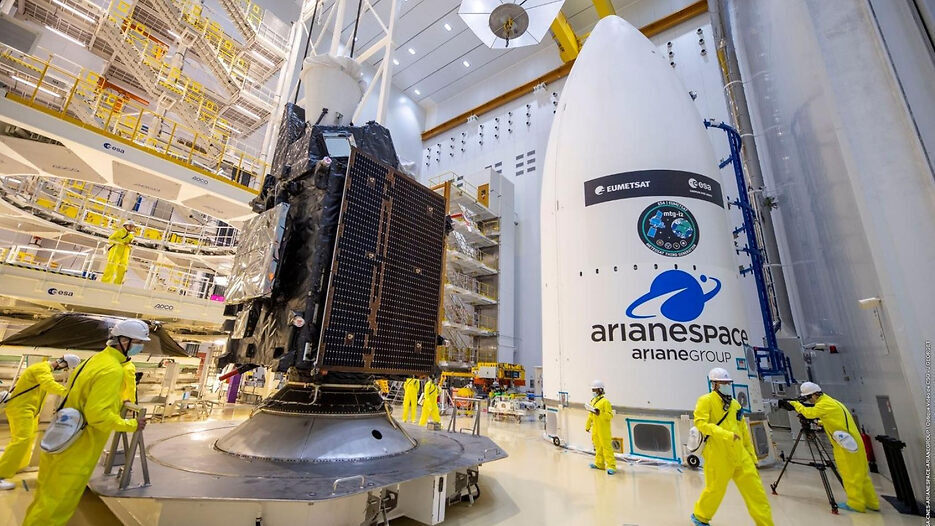
Arianespace successfully launched the MTG-I2 weather satellite from Europe’s Spaceport on Monday using an Ariane 62 launcher. The MTG-I2 is the second imaging satellite in the Meteosat Third Generation (MTG) program, a collaborative project between the European Space Agency and EUMETSAT designed to maintain high-resolution weather monitoring for Europe and Africa beyond 2040.
The satellite was built by Thales Alenia Space, a joint company owned 67% by Thales and 33% by Leonardo, in cooperation with OHB. Designed to operate in geostationary orbit at an altitude of 36,000 km, the MTG-I2 has a nominal operational lifespan of 8.5 years.
The MTG-I2 joins the Meteosat-12 imaging satellite and the MTG-S1 atmospheric sounding satellite to form the first constellation of the MTG system. While Meteosat-12 provides imagery over Europe and Africa every 10 minutes, the MTG-I2 will capture images over Europe every 2.5 minutes in its quick mode. This capability provides weather imagery at an unprecedented rate and accuracy.
Equipped with a new-generation flexible combined imager, the MTG-I2 can deliver a complete image of the Earth across 16 wavebands in just 10 minutes, compared to 15 minutes for the previous generation. The satellite also features an improved spatial resolution between 500 meters and 1 km. This technology is intended to enhance the accuracy of weather forecasts from several minutes to several hours before events occur.
The integration of high-resolution imagery from Meteosat-12 and MTG-I2 with sounding data from MTG-S1 aims to improve nowcasting capabilities. This allows for the near-real-time monitoring and forecasting of extreme weather phenomena, such as violent thunderstorms, which pose an increasing threat due to climate change.
The launch marks a significant advancement in meteorological capabilities. While first-generation Meteosat satellites provided updates every 30 minutes and second-generation models every 15 minutes, the MTG system reduces the refresh rate to 10 minutes for full disk mode and 2.5 minutes for European quick mode.
Telespazio, a joint venture between Leonardo and Thales, provided launch and early orbit phase services for the MTG-I2, as well as the previously launched Meteosat-12 and MTG-S1. The company also manages the ground segment for data acquisition and satellite command and control. A successor constellation of three satellites is planned for launch no earlier than 2033.